
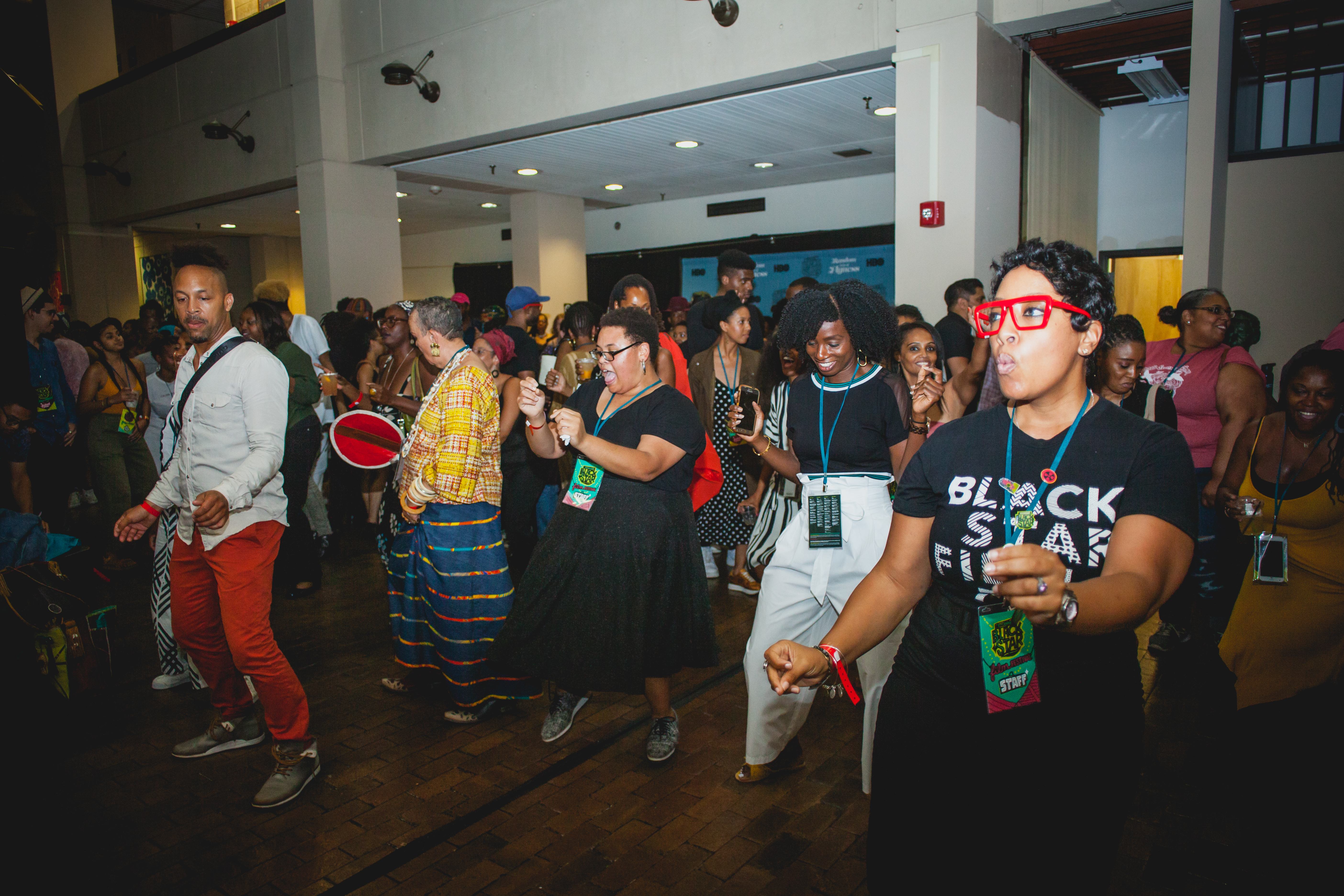


The BlackStar Film Festival kicks off in Philly today, and we here at BGDM are feeling particularly festive as we prepare to honor Maori Karmael Holmes (Chief Executive and Artistic Officer) and Nehad Khader (Festival Director) at our annual Community Mixer on Friday, August 7th. While our gathering during the legendary fest is always a good time, working alongside our partners at Documentary Accountability Working Group (DAWG) to shine a light on the 15 years of care, imagination, and stewardship from Karmael Holmes and Khader feels particularly resonant this year, as we've been reflecting on our own decade in the field. It sometimes feels as though organizations like ours have grown up together, buoyed by our collective vision of creating spaces where Black, Brown, and indigenous filmmakers can find community, inspiration, and belonging.
To throw another sweet milestone into the mix, the Mixer will be preceded by a 20th anniversary screening of Karmael Holmes' Scene Not Heard: Women in Philadelphia Hip Hop. As if this queen wasn't busy enough, she co-curated the beautiful Freedom Dreams exhibition at The Barnes Foundation, an immersion in the memories, dreams, and histories of Black American artists like Garrett Bradley and Ja'Tovia Gary (both BGDM members), conveniently on through BlackStar weekend.
Maori Karmael Holmes miraculously found a little time ahead of the opening of the festival and the closing of the exhibit to share her thoughts on making art and building community.
1) Let's go back to the industry landscape of the 2010s for a moment…was there a particular need from our Black and Brown communities that the founding of BlackStar was responding to?
I think there is always a need for community, but perhaps in 2012, when BlackStar started, there was a specific need that emerged for filmmakers of color who were making work that was busting out of genre and beginning to really be taken seriously in the art world. Documentaries were quickly changing form. At that time, there was also a reemergence of the aesthetics of Afrofuturism, and for a few years there seemed to be a focus on independent Black and Brown directors, so we were a space for folks to see new work, think about making their own, and connect.
2) What have you learned over the years about what it takes to make people feel like they belong?
We always strive to treat all filmmakers the same—no matter how accomplished or emergent they might be. We also have always seen filmmakers as our first audience. So many of us as organizers are filmmakers, and so we're addressing 'us' first, and then outward to concentric circles. I believe we can't ever take the audience for granted, and so we are always working on ensuring that folks feel included - within our control.
3) BGDM: Countless BGDM members find collaborators, mentors, lifelong friends at BlackStar. Are there moments of connection you've witnessed over the years that have stayed with you?
It's been really incredible to hear from folks how attending BlackStar has been meaningful in their lives. In our first year, two filmmakers met and eventually married, which I think kicked off very high expectations! But in smaller ways, I know at least two people who began making films because they felt like it was possible after attending the festival. And now we're in a place where children who attended then decided they wanted to become filmmakers, and at least one returned to the festival with a film. That's also really moving.
4) BGDM: Can you describe the culture of BlackStar, and what you feel makes it special? What's something about the spirit of BlackStar that you fiercely protect, even if it might not be consciously noticed?
I think it's hard for me to have real perspective on the culture as someone deeply immersed in it. The first year I was really thinking about what my friends and I might want to see and hoping other people wanted to see that work too—organized in the manner I found interesting. We focused on building a program that represents something dynamic and exciting and presents new visions of the world. We focus on that. But that said, I am proud that we are inclusive and that folks desire to dress up and show off at the festival. That means it's a space where they can feel seen.
5) This year, you will be bringing one of your earlier films to BlackStar. How does it feel to return to the fest with a renewed appreciation for a film that you made 20 years ago?
My film has never shown at BlackStar. It is somewhat surreal to have something that I made so long ago be showing now. The film is screening as part of our festival origin story because so many of the relationships I made with the production and distribution of the film led to me starting BlackStar.
6) How does the experience of attending BlackStar as a filmmaker feel different from the work of creating that space for others?
I screened a music video that I directed for India.Arie at the 2019 festival, but I think it went quietly under the radar, so I didn't feel like a filmmaker. I actually often tell people that I don't know what it's like to 'attend' BlackStar at all, which is true. I don't run around in 2026 the way I had to in 2019, but I am still being pulled in a million directions for the entire four days. This year I think a lot more folks are aware of this retrospective screening.
7) How have you protected your own artistic practice over the years? Do you see a relationship between your community building and your art making?
I have not really had a lot of space for making work over the years. For the first 9 years of the festival, it was organized outside of my full-time work, so I didn't have time to make art as well, not really. And even since 2020, I've spent a lot of my 'free' time taking on ambitious curatorial projects like Terence Nance: Swarm, which was on exhibit at the ICA Philadelphia in 2023, and Freedom Dreams, which is up now at The Barnes. Music videos have been my primary artistic outlet as I've been able to direct and co-direct a few over the years while also organizing BlackStar. I am someone who has always been obsessed with history, culture, and beauty, and my artistic work and the festival both come from those same impulses.
8) What has returning to your own creative work taught you about sustaining a life in documentary?
I don't feel like I have done this yet. Now that Blackstar is a full-time job for me, I am working on reconnecting with rest and discovering what not working all hours of the day feels like. It's taking some time. And I have started a new documentary film project. Fundraising is moving somewhat slowly, but that's okay.
9) If someone is attending both BlackStar and a BGDM gathering for the very first time this year, what do you hope they'll carry with them long after the festival ends?
I hope that someone who attends BlackStar for the first time this year leaves with a sense of awe and wonder at the work they experienced and finds new comrades in their fellow attendees. We seek to be a lighthouse in tumultuous times and know that each person can also be a lighthouse in their own way.
10) As we celebrate these milestones, we're also thinking about the future. What do you hope organizations like BlackStar and BGDM continue to build over the next decade-for artists, for audiences, and for the field?
I hope that artists, audiences, and the field continue to feel like BlackStar and BGDM can be a home for them, that they continue to spread the word, and that folks feel like BlackStar can be a place where they will succeed if they have their world premiere with us!
Tags:
Categories:
Home Features /
Stories /